Models
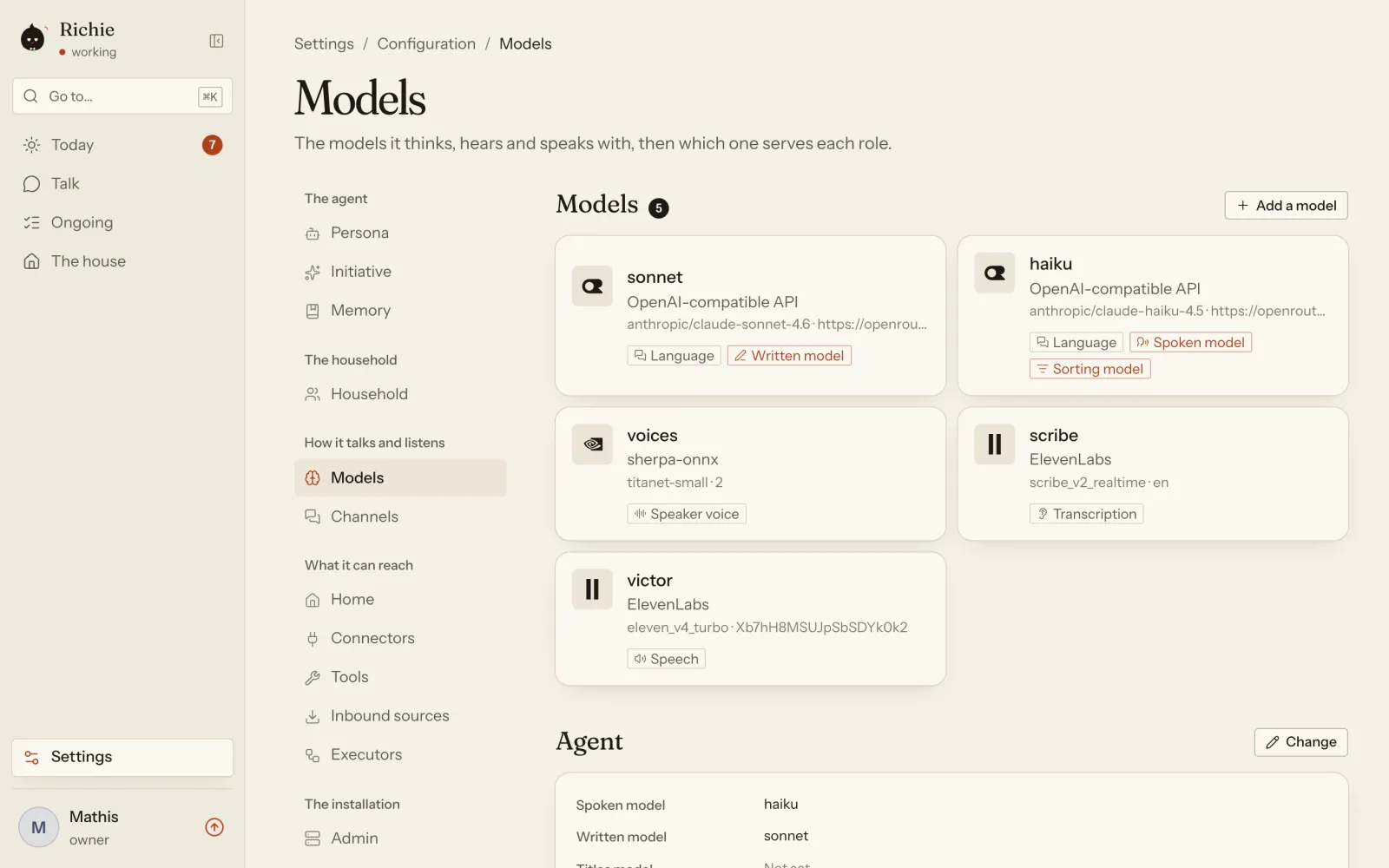
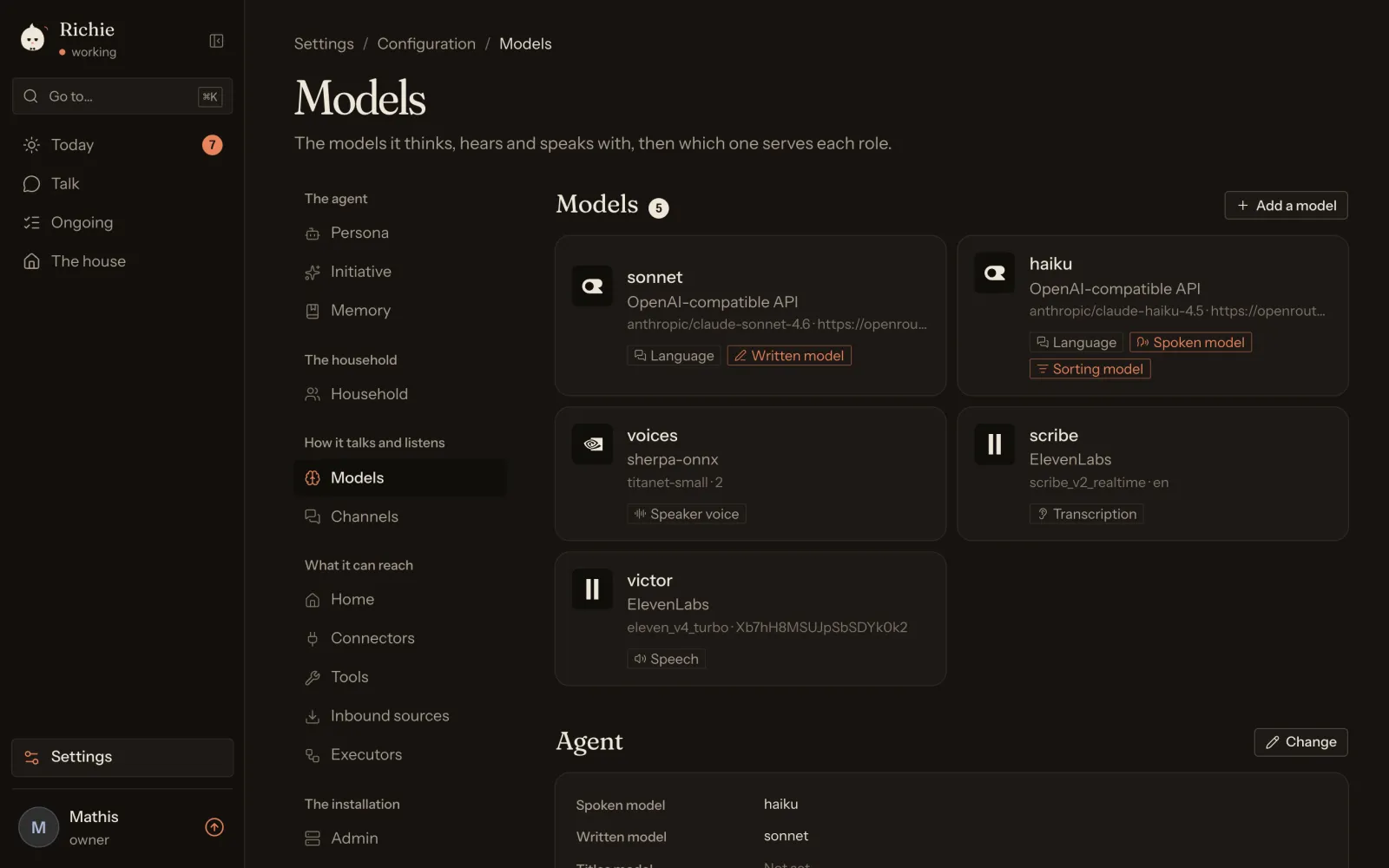
The language model the agent thinks with, one per role if you like, a fallback, and the models for memory search and pictures.
Any language model, hosted or local, that supports tool calls.
Choose a provider
nestor init writes one profile, models.main. To change provider, replace it with a block below,
then nestor check. The key goes in .env as MODEL_API_KEY; local servers need none.
The default, and the tested provider.
MODEL_API_KEY=sk-or-...models:
main:
type: language
provider: openai-compatible
base_url: https://openrouter.ai/api/v1
api_key: ${MODEL_API_KEY}
model: anthropic/claude-haiku-5.5MODEL_API_KEY=sk-...models:
main:
type: language
provider: openai-compatible
base_url: https://api.openai.com/v1
api_key: ${MODEL_API_KEY}
model: gpt-5-miniMODEL_API_KEY=...models:
main:
type: language
provider: openai-compatible
base_url: https://api.mistral.ai/v1
api_key: ${MODEL_API_KEY}
model: mistral-small-latestMODEL_API_KEY=gsk_...models:
main:
type: language
provider: openai-compatible
base_url: https://api.groq.com/openai/v1
api_key: ${MODEL_API_KEY}
model: openai/gpt-oss-120bNative: PDFs read whole, prompt cached by Gemini.
MODEL_API_KEY=...models:
main:
type: language
provider: gemini
api_key: ${MODEL_API_KEY}
model: gemini-flash-latestextra_body carries generationConfig (thinkingConfig, maxOutputTokens).
Native: prompt and conversation cached, PDFs read whole.
MODEL_API_KEY=sk-ant-...models:
main:
type: language
provider: anthropic
api_key: ${MODEL_API_KEY}
model: claude-haiku-5-5effort (low to max) sets how much Claude thinks; max_tokens caps the answer, thinking
included (64000).
model is one the server has pulled.
models:
  main:
    type: language
    provider: openai-compatible
    base_url: http://localhost:11434/v1
    model: qwen3
model is the loaded model’s identifier.
models:
  main:
    type: language
    provider: openai-compatible
    base_url: http://localhost:1234/v1
    model: qwen3-8b
Set a key only if vLLM runs with --api-key.
models:
  main:
    type: language
    provider: openai-compatible
    base_url: http://localhost:8000/v1
    model: Qwen/Qwen3-8B
llama-server serves the model it loaded, whatever model says.
models:
  main:
    type: language
    provider: openai-compatible
    base_url: http://localhost:8080/v1
    model: local
A local model is slower, and the voice feels it first. From Docker, use
http://host.docker.internal:<port>/v1; on Linux, make the server listen on all interfaces
(OLLAMA_HOST=0.0.0.0, --host 0.0.0.0 for llama.cpp).
Types
Each model has a type (language, embedding, transcription, speech, speaker, image)
and a provider. See Voice and Speakers.
Roles
| Role | What it does | When unset |
|---|---|---|
agent.spoken |
answers aloud: the first words must come fast | agent.written |
agent.written |
answers in writing | agent.spoken |
agent.titles |
titles each chat of the admin; a small model does | agent.written |
watches.model |
sorts incoming mail for the watches | agent.written |
memory.consolidation |
summarizes each conversation once it is over | agent.written |
agent.transcription |
hears voice messages | the only transcription model |
agent.speech |
answers a voice message with one | the only speech model |
agent.images |
draws pictures | the only image model |
A fast model for the voice, a stronger one in writing:
models:
  quick:
    type: language
    provider: openai-compatible
    base_url: https://openrouter.ai/api/v1
    api_key: ${MODEL_API_KEY}
    model: anthropic/claude-haiku-5.5
  deep:
    type: language
    provider: openai-compatible
    base_url: https://openrouter.ai/api/v1
    api_key: ${MODEL_API_KEY}
    model: anthropic/claude-sonnet-5.5

agent:
  spoken: quick
  written: deep
Settings
| Key | Models | What it does |
|---|---|---|
extra_body |
all language models | merged into every request (routing, reasoning, generationConfig) |
read_timeout_s |
all language models | in seconds: 30 for openai-compatible, 60 for anthropic and gemini |
fallback |
all language models | the model that answers when this one fails (Fallback) |
vision |
openai-compatible |
true for a model that reads images: it then sees the photos sent |
cache_control |
openai-compatible |
the provider’s prompt cache, on by default for OpenRouter and Anthropic |
anthropic and gemini see images and read PDFs by themselves.
Fallback
When a model fails before answering, its fallback answers, in every role, and the journal says
so. A fallback may have its own, and gets no pictures or documents it cannot take.
models:
  claude:
    type: language
    provider: anthropic
    api_key: ${ANTHROPIC_API_KEY}
    model: claude-sonnet-5-5
    fallback: gemini
  gemini:
    type: language
    provider: gemini
    api_key: ${GEMINI_API_KEY}
    model: gemini-flash-latest
A model that fails mid-answer is not replaced.
Search by meaning
An embedding model finds memories by meaning (“what does Léa eat?” finds “Léa is vegetarian”):
models:
  vectors:
    type: embedding
    provider: openai-compatible
    base_url: https://openrouter.ai/api/v1
    api_key: ${MODEL_API_KEY}
    model: openai/text-embedding-3-small
    dimensions: 1536

memory:
embedder: vectors| Key | What it does |
|---|---|
dimensions |
the vector size |
send_dimensions |
true asks a model that can shorten its vectors for that size |
query_prefix, document_prefix |
for a model that expects a prefix (query: ) |
Any OpenAI-compatible /embeddings endpoint works (Memory).
Pictures
Nestor sends the pictures it draws in the admin’s chat and messaging apps. One asked for aloud stays in the admin’s journal.
models:
  painter:
    type: image
    provider: openai-compatible
    base_url: https://openrouter.ai/api/v1
    api_key: ${MODEL_API_KEY}
    model: google/gemini-2.5-flash-image
    endpoint: chat
endpoint: images (default) uses /images/generations; chat uses Chat Completions, as on
OpenRouter. size sets the size when the model takes one (1024x1024).